Snowflake: A Deep Dive into the Data Cloud Giant

Snowflake has rapidly become a dominant force in the cloud data platform market. This report provides an in-depth analysis of Snowflake, examining its products and services, financial performance, competitive landscape, and future prospects. We delve into the company's recent news and controversies, explore its business model, and compare it with its main competitors. This comprehensive analysis aims to provide a thorough understanding of Snowflake's position in the evolving data cloud landscape.
Snowflake's Mission and Vision
Snowflake's mission is to mobilize the world's data1. This mission is reflected in their commitment to providing a cloud-based data platform that enables organizations to access, share, and analyze data seamlessly. Their vision is to be the data platform that powers the Data Cloud, a global network of data providers and consumers. This vision guides their product development and market approach, focusing on building a platform that fosters data collaboration and innovation.
Snowflake's Products and Services
Snowflake offers a cloud-based data platform, the Snowflake Data Cloud, designed to handle diverse data workloads, including data warehousing, data lakes, data engineering, and application development2. The platform's architecture allows for independent scaling of compute and storage resources, enabling users to optimize costs and performance3. Snowflake promotes a consumption-based pricing model, where customers pay only for the resources they use4.
Some of Snowflake's key products and services include:
Data Warehouse: Snowflake's cloud-native data warehouse provides a high-performance, scalable solution for analytical workloads5. It supports various data types and formats, enabling users to consolidate data from diverse sources.
Data Lake: Snowflake's data lake allows users to store and query structured and unstructured data in a single platform5. This facilitates data discovery and exploration, enabling data scientists and analysts to extract valuable insights.
Data Engineering: Snowflake provides tools and services for building and managing data pipelines5. Users can perform data integration, transformation, and loading tasks using SQL or Python.
Application Development: Snowflake enables developers to build and deploy data-intensive applications on its platform5. This allows for the creation of data-driven applications and services.
Collaboration: Snowflake promotes data sharing and collaboration through its Data Marketplace and secure data sharing capabilities5. This allows organizations to access and share data with partners and customers securely.
Cloud Services: Snowflake offers a suite of cloud services that enhance the value proposition of the Data Cloud. These services include:
Security Hub: Provides a centralized platform for managing security policies, monitoring threats, and ensuring compliance1.
Cost & Performance Optimization: Offers tools and services to help users optimize their Snowflake usage and minimize costs1.
Snowflake for Developers
Snowflake recognizes the importance of a thriving developer ecosystem and provides a range of resources to empower developers to build and scale data-driven applications. These resources include:
Snowflake for Developers: A dedicated portal with comprehensive documentation, tutorials, and code samples to help developers get started with Snowflake1.
Solutions Center: Provides reference architectures, use cases, and best practices for building applications on Snowflake1.
Downloads: Offers access to the latest software versions, drivers, libraries, and relevant documentation1.
Open Source: Snowflake actively contributes to and supports key open-source projects related to data management and analytics1.
Partnerships and Ecosystem
Snowflake has built a strong partner network that plays a crucial role in expanding its reach and offering comprehensive solutions to customers. The Snowflake Partner Network includes:
Technology Partners: Collaborate with Snowflake to integrate their technologies and provide joint solutions.
Consulting Partners: Help customers implement and optimize Snowflake solutions.
Data Providers: Offer valuable data sets and services through the Snowflake Marketplace.
These partnerships enable Snowflake to provide a broader range of solutions and services, catering to diverse customer needs and industry verticals.
Snowflake's Business Model and Pricing
Snowflake's business model is centered around its consumption-based pricing structure. This model allows customers to pay only for the resources they consume, making it a cost-effective solution for organizations of all sizes3. Snowflake's pricing is based on a unit called "Snowflake Credits." These credits are used to pay for compute resources, storage, and cloud services3.
Snowflake offers different pricing tiers to cater to various needs and budgets. These tiers provide different levels of compute resources, storage capacity, and support services3.
Target Market:
Snowflake's target market includes a wide range of organizations, from small businesses to large enterprises, across various industries4. Key customer segments include:
Companies: Businesses of all sizes that require a scalable and high-performance data platform for analytics, data warehousing, and data science.
Government Organizations: Public sector agencies that need to manage and analyze large volumes of data for public services and decision-making.
Non-profit Organizations: Non-profit entities that require a cost-effective data platform to support their missions and operations.
Snowflake's Financial Performance
Snowflake has demonstrated impressive financial growth in recent years. According to its latest 10-K filing, the company's total revenue for the fiscal year 2023 was $1.2 billion, with a gross profit of $789 million6. While the company reported a net loss of $797 million for the same period, it has shown improvement in its operating margins and is on track to achieve profitability in the future6. Snowflake's revenue has consistently grown year-over-year, driven by strong product adoption and expansion within existing customer accounts6.
Key highlights from Snowflake's financial performance include:
Revenue Growth: Snowflake's product revenue grew by 78% between fiscal years 2023 and 20257. This growth is attributed to the increasing adoption of cloud data platforms and Snowflake's strong product offerings.
Profitability: Snowflake aims to achieve profitability by optimizing its operating expenses and increasing its revenue through product innovation and customer acquisition6.
Strong Balance Sheet: Snowflake has a healthy balance sheet with significant cash reserves, providing the company with financial flexibility for future investments and growth initiatives6.
Recent News and Developments
Snowflake has been actively expanding its product offerings and partnerships. Some of the recent news and developments include:
New CEO: Snowflake appointed Sridhar Ramaswamy as its new CEO in January 20258. Ramaswamy brings extensive experience in technology and AI, signaling Snowflake's focus on AI-driven data solutions.
One Million Minds + One Platform Program: Snowflake launched a $20 million program to provide AI upskilling opportunities to students and workers in high-growth and emerging markets9. This initiative aims to address the growing demand for AI and data skills.
Open Sourcing SwiftKV: Snowflake open-sourced SwiftKV, a key-value store designed to reduce inference workload costs8. This move reflects Snowflake's commitment to open-source technologies and its focus on cost optimization for AI applications.
Data for Breakfast Events: Snowflake is hosting "Data for Breakfast" events in over 100 cities worldwide to showcase its analytics and AI capabilities1. These events aim to engage customers and promote Snowflake's data solutions.
Partnership with JPXI: Snowflake partnered with JPXI to expand access to Japan's financial market data through its platform10. This partnership strengthens Snowflake's position in the financial services industry.
Snowflake's Competitors
Snowflake operates in a competitive market with several major players. Its main competitors include:
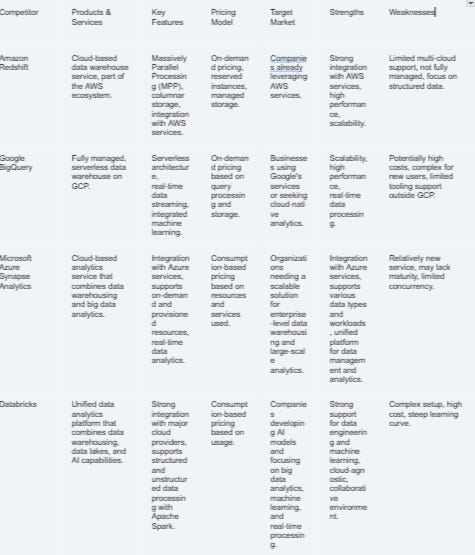
Competitive Advantage
Snowflake's competitive advantage stems from several key factors that differentiate it from its competitors:
Unique Architecture: Snowflake's multi-cluster, shared-data architecture allows for independent scaling of compute and storage resources, providing flexibility and cost optimization3. This architecture also enables high concurrency and performance for diverse workloads.
Multi-Cloud Support: Snowflake supports major cloud providers like AWS, Azure, and GCP, allowing customers to avoid vendor lock-in and choose the best cloud environment for their needs12. This multi-cloud approach provides flexibility and resilience.
Data Sharing Capabilities: Snowflake's secure data sharing capabilities enable organizations to collaborate and share data with partners and customers seamlessly5. This fosters data ecosystems and unlocks new opportunities for data monetization and innovation.
Snowflake's AI Strategy
Snowflake is actively investing in AI and machine learning to enhance its platform and empower users. The company's AI strategy focuses on:
AI-Driven Data Solutions: Snowflake aims to integrate AI capabilities into its platform to automate tasks, improve performance, and provide intelligent insights8.
Empowering Users with AI: Snowflake provides tools and services to enable users to build and deploy AI models on its platform9. This includes access to pre-trained models, tools for model development, and support for popular machine learning frameworks.
Driving Future Growth with AI: Snowflake sees AI as a key driver of future growth and innovation1. The company is investing in research and development to advance its AI capabilities and expand its AI-powered offerings.
Data Governance and Security
Snowflake prioritizes data governance and security to ensure data privacy, compliance, and integrity. The platform offers a range of security features and capabilities, including:
Security Controls: Snowflake provides robust security controls, such as identity and access management, network security, and encryption, to protect data at rest and in transit5.
Unified Governance Model: Snowflake's unified governance model enforces policies, tags, and lineage to ensure data consistency and compliance5.
Compliance Certifications: Snowflake complies with various industry standards and regulations, such as GDPR, HIPAA, and PCI DSS, to meet the security and privacy requirements of different sectors13.
Controversies and Challenges
Despite its strengths and successes, Snowflake has faced some controversies and challenges:
Data Breaches: Snowflake has been involved in data breaches where customer data was exposed due to misconfigured security settings14. These incidents highlight the shared responsibility model of cloud security and the importance of proper configuration and management by users.
Cost Optimization: Some users have raised concerns about the complexity of managing costs in Snowflake, particularly for unpredictable workloads15. This requires careful monitoring of resource utilization and optimization strategies to avoid unexpected costs.
Performance Bottlenecks: While Snowflake generally offers high performance, some users have reported performance issues for specific workloads or queries16. This can be attributed to factors like query design, data modeling, and resource allocation. Addressing these issues requires careful tuning and optimization.
Analyst Reports and Future Prospects
Analysts generally have a positive outlook on Snowflake's future prospects. The company's strong financial performance, expanding product offerings, and focus on AI position it for continued growth in the data cloud market17.
Key insights from analyst reports include:
Growth Potential: Analysts predict continued revenue growth for Snowflake, driven by increased adoption of cloud data platforms and Snowflake's strong market position18.
AI Focus: Snowflake's investments in AI and machine learning are expected to drive innovation and differentiation in its product offerings19.
Competitive Landscape: Analysts recognize the competitive landscape but believe Snowflake's strengths and strategic partnerships will enable it to maintain its market leadership18.
Analyst Ratings: Based on 38 Wall Street analysts, Snowflake has a consensus rating of "Moderate Buy" with an average price target of $187.0618.
Conclusion
Snowflake is a leading cloud data platform provider with a strong track record of growth and innovation. The company's cloud-native architecture, comprehensive offerings, and focus on AI position it for continued success in the evolving data cloud market. Snowflake's commitment to data governance and security provides a robust and trusted platform for organizations to manage their valuable data assets. While the company faces challenges in terms of competition, cost management, and addressing specific customer needs, its strengths and strategic partnerships suggest a positive outlook for its future. By effectively navigating these challenges and continuing to innovate, Snowflake is well-positioned to maintain its leadership in the data cloud landscape.
Works cited
1. The Snowflake AI Data Cloud - Mobilize Data, Apps, and AI, accessed on February 10, 2025, https://www.snowflake.com/en/
2. Snowflake (SNOW) 10K Form and SEC Filings 2025 - MarketBeat, accessed on February 10, 2025, https://www.marketbeat.com/stocks/NYSE/SNOW/sec-filings/
3. What is Snowflake's business model? - Vizologi, accessed on February 10, 2025, https://vizologi.com/business-strategy-canvas/snowflake-business-model-canvas/
4. Snowflake Business Model - How Snowflake Makes Money? - Business Model Analyst, accessed on February 10, 2025, https://businessmodelanalyst.com/snowflake-business-model/
5. Snowflake for Data Warehousing, accessed on February 10, 2025, https://www.snowflake.com/en/data-cloud/workloads/data-warehouse/
6. Form 10-K for Snowflake INC filed 03/29/2023, accessed on February 10, 2025, https://s26.q4cdn.com/463892824/files/doc_financials/2023/q4/0d4be772-30ac-4017-a78b-a5eaa081840e.pdf
7. Snowflake Revenues: How Does SNOW Make Money? - Trefis, accessed on February 10, 2025, https://www.trefis.com/data/companies/SNOW/no-login-required/wPDS2hBY/Snowflake-Revenues-How-Does-SNOW-Make-Money-
8. Snowflake News Coverage, accessed on February 10, 2025, https://www.snowflake.com/en/news/news-coverage/
9. Snowflake Launches One Million Minds + One Platform Program, Investing $20 Million Toward AI Upskilling, accessed on February 10, 2025, https://www.snowflake.com/en/news/press-releases/snowflake-launches-one-million-minds-one-platform-program-investing-20-million-toward-ai-upskilling/
10. SNOW - Snowflake Inc. Latest Stock News & Market Updates, accessed on February 10, 2025, https://www.stocktitan.net/news/SNOW/
11. Snowflake Alternatives: 4 Data Warehousing Competitors - Vendr, accessed on February 10, 2025, https://www.vendr.com/blog/snowflake-alternatives-competitors
12. Top Snowflake AI Data Cloud Competitors & Alternatives 2025 | Gartner Peer Insights, accessed on February 10, 2025, https://www.gartner.com/reviews/market/cloud-database-management-systems/vendor/snowflake/product/snowflake-ai-data-cloud/alternatives
13. Overcoming Snowflake Challenges - A Practical Guide - Astera Software, accessed on February 10, 2025, https://www.astera.com/knowledge-center/overcoming-snowflake-challenges/
14. Latest Snowflake news - Bleeping Computer, accessed on February 10, 2025, https://www.bleepingcomputer.com/tag/snowflake/
15. 5 Snowflake struggles that every Data Engineer deals with - Tinybird, accessed on February 10, 2025, https://www.tinybird.co/blog-posts/5-snowflake-struggles-that-every-data-engineer-deals-with
16. Snowflake Performance Challenges & Solutions (Part 1) | by Slim Baltagi - Medium, accessed on February 10, 2025, https://medium.com/@sbaltagi/snowflake-performance-challenges-solutions-part-1-b91fe74c31f3
17. Snowflake (SNOW) Stock Forecast, Price Targets and Analysts Predictions - TipRanks.com, accessed on February 10, 2025, https://www.tipranks.com/stocks/snow/forecast
18. Snowflake (SNOW) Stock Forecast and Price Target 2025 - MarketBeat, accessed on February 10, 2025, https://www.marketbeat.com/stocks/NYSE/SNOW/forecast/
19. Snowflake (SNOW) Stock Price, Quote, News & Analysis - TipRanks.com, accessed on February 10, 2025, https://www.tipranks.com/stocks/snow